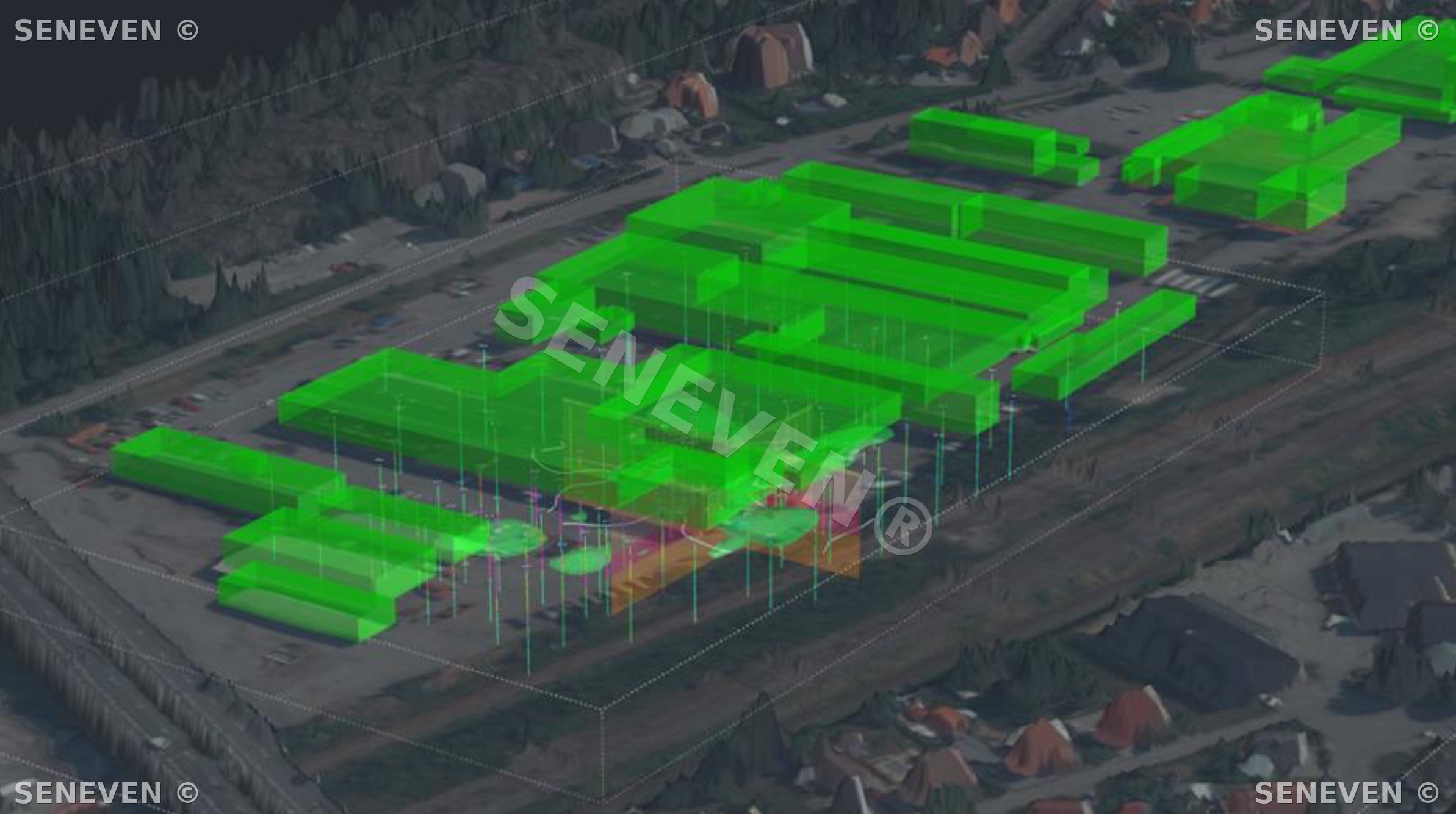
High-Resolution Site Characterization & Visualization
Advanced high-resolution direct push site characterization with 3D visualization.
Engineering Background
Challenge: limitations of conventional investigations. Landfills are typical complex pollution sources that can cause multiple environmental issues: leachate leakage contaminating groundwater and soil; gas diffusion releasing methane and other harmful gases; liner damage allowing uncontrolled contaminant release. Traditional investigations—such as drilling and discrete sampling—provide only scattered point data that struggle to reveal the true distribution of contamination. This "point-for-area" approach easily misses critical migration pathways and hot spots, biasing the assessment and yielding poorly-targeted remediation designs that raise costs while reducing effectiveness.
- Electrical Resistivity Tomography (ERT): non-invasive geophysics mapping plumes and strata
- Membrane Interface Probe (MIP): direct-push in-situ detection of subsurface VOCs and pathways
- Laser-Induced Fluorescence (LIF): high-resolution petroleum-hydrocarbon detection and NAPL mapping
- Optimized remediation design: precision data enables targeted treatment
- Cost and time savings: less repeated investigation and over-remediation
- Greater project certainty: reliable data instills confidence in owners, regulators and public
Principle & Method
Solution: High-Resolution Site Characterization (HRSC)—a modern approach that delivers fine 3D information on subsurface contamination. Key advantages over traditional methods: precise localization (accurate identification of sources, plume boundaries and migration pathways); real-time decision making (rapid on-site data allows adaptive investigation strategies and single-mobilization comprehensive surveys); reduced uncertainty (high-density data builds a reliable Conceptual Site Model, CSM, as a solid foundation for remediation). Core HRSC tools include Electrical Resistivity Tomography (ERT), Membrane Interface Probe (MIP) and Laser-Induced Fluorescence (LIF). Choosing HRSC is choosing a more scientific and accountable path for landfill environmental management and remediation.
Typical Scenarios & Diagrams
Need technical support?
Contact the SENEVEN engineering team for a tailored detection or monitoring scope, scaled to your project type, footprint and field conditions.