SENEVEN® Permanent Leak Location System (PLLS)
Continuous geoelectrical monitoring of geomembrane lining systems with automatic defect localisation and threshold-based alerting—24/7 over the service life of the asset.
Engineering Background
The SENEVEN® Permanent Leak Location System (PLLS), developed by SENEVEN Technology (Shanghai), is a continuous, automated leak-location and integrity-monitoring solution for geomembrane lining systems. Sensors and cables are pre-installed above and below the primary liner during construction; once energised, the system performs round-the-clock acquisition of electric-potential and current-density data, applying ASTM D6747-class electrical leak-location principles continuously rather than as a one-off post-construction survey. An optional chemical-signature channel records the conductivity of any infiltrating leachate or process liquid, refining localisation. Owners can configure the system in electrical-only, chemical-only or dual-mode operation to match the chemistry, geometry and risk profile of each project.
- Continuous, 24/7 unattended operation throughout the service life of the lining system
- Dual-parameter acquisition—synchronous electric-field and conductivity channels
- Pre-installed embedded sensor network—multi-parameter sensing nodes coupled to a conductive geotextile carrier
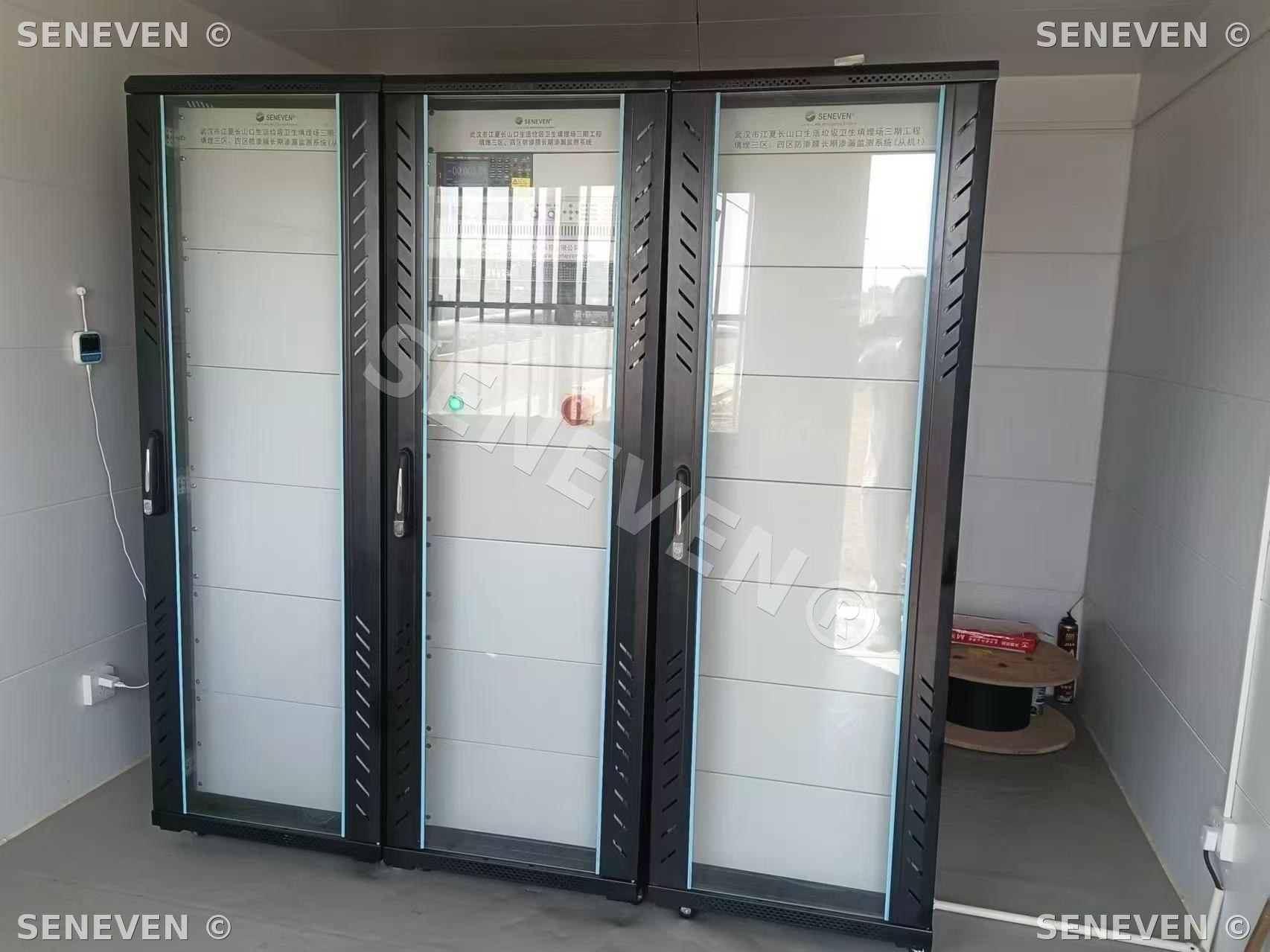
- 19-inch rack-mounted acquisition and control cabinet with fault-tolerant power management and high-precision data acquisition
- Cloud-based analytics with automatic defect-coordinate computation and 2-D / 3-D potential-field visualisation
- Threshold-based alerting—exceedances trigger automated notifications to operations personnel
- Full-lifecycle data management—real-time acquisition, archival, audit logging and operator dashboards
Principle & Method
The PLLS combines two complementary measurement modalities.
1. Electrical leak location. The geomembrane behaves as a near-ideal dielectric between two conductive media. The system establishes a controlled potential difference across the liner; an intact membrane sustains a uniform far-field distribution while any breach creates a local low-resistance path that perturbs the field. Reference and roving sensor pairs sample the resulting equipotential anomalies, and inversion algorithms map their spatial signature to defect coordinates with metre-scale resolution.
2. Chemical-signature monitoring. Smart sensing electrodes installed beneath the liner respond to the conductivity—and other electrochemical parameters—of any liquid that reaches them. A step change in conductivity at a given sensor flags both the occurrence and the approximate location of leakage and is fused with the electrical-channel result to improve overall localisation accuracy.
Continuous integration of these two data streams over time turns a passive lining system into an instrumented, self-reporting asset, providing the evidentiary basis for targeted investigation and repair.
Typical Scenarios & Diagrams
System Principle
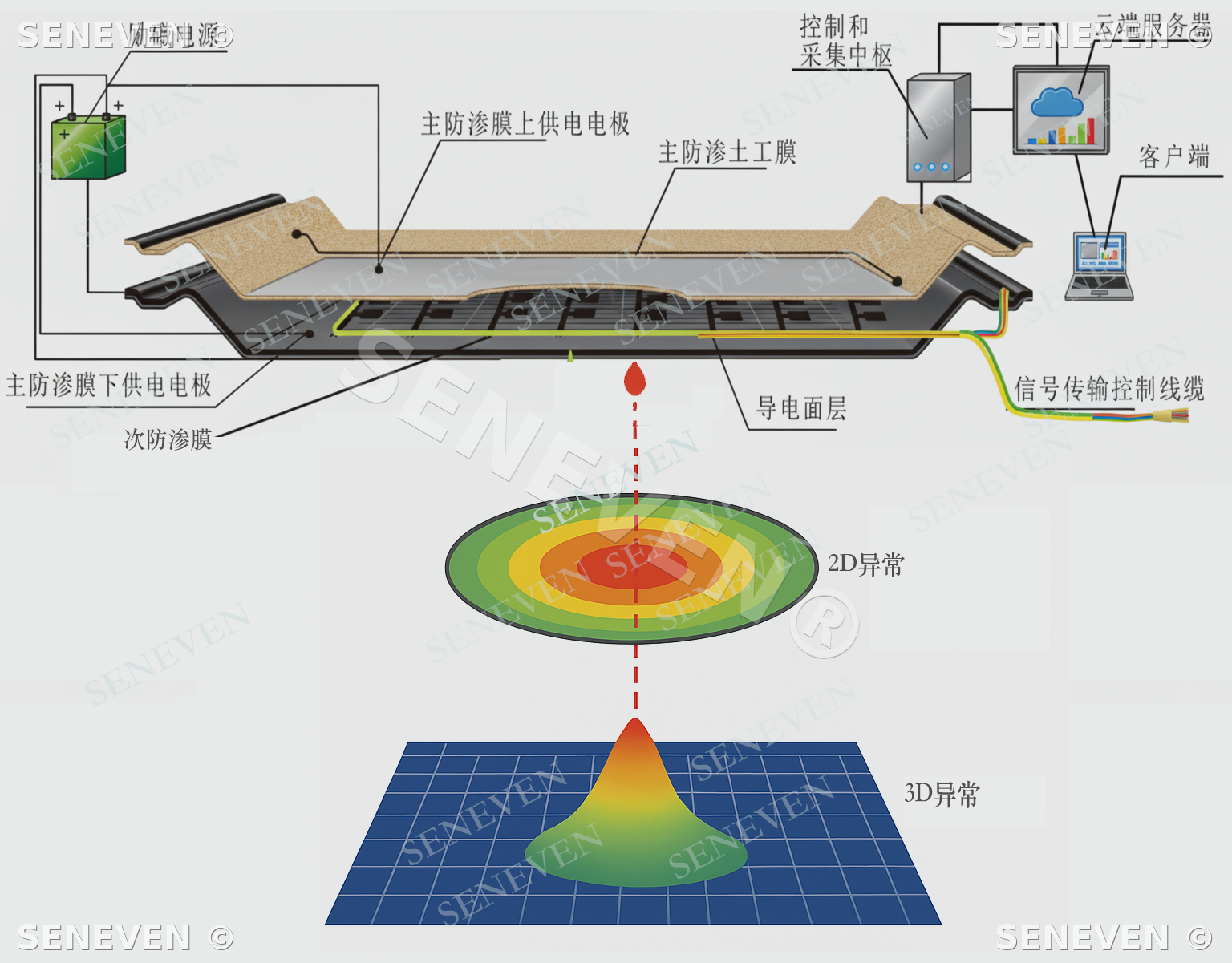
Operating principle of the SENEVEN® Permanent Leak Location System.
1. Electrical leak location. The geomembrane behaves as a near-ideal dielectric. A controlled electric field is impressed across the liner via electrodes installed above and below the membrane. An intact liner yields a uniform potential distribution; a breach forms a local low-resistance current path that distorts the field. Reference and roving sensor pairs sample these equipotential anomalies, and inversion algorithms map their spatial signature to defect coordinates.
2. Chemical-signature monitoring. Smart sensing electrodes installed beneath the liner respond to the conductivity—and other electrochemical parameters—of any infiltrating liquid. A step change in conductivity flags the occurrence and approximate location of leakage; fusion with the electrical-channel result improves overall localisation accuracy.
By continuously combining electrical and chemical observations and analysing the data record over time, the system delivers georeferenced defect coordinates and a defensible audit trail for investigation and repair.
System Composition
The SENEVEN® Permanent Leak Location System (PLLS) is a fully integrated continuous monitoring solution for geomembrane lining systems, providing all-weather, online integrity surveillance and automatic defect localisation.
Acquired data streams. Pre-installed sensor pairs above and below the primary geomembrane acquire electric-potential and current-density data continuously, supporting real-time integrity assessment of the liner system. The optional chemical-signature channel records the conductivity of any infiltrating liquid and is fused with the electrical record to refine localisation.
Subsystems and functions: • Embedded monitoring units — multi-parameter sensors, conductive geotextile carrier, and signal-transmission and control cabling, pre-installed above and below the geomembrane for distributed acquisition. • Acquisition and control cabinet — power supply, fault-tolerant power-control module, acquisition and control modules, high-precision data-acquisition unit and master server, integrated in a standard 19-inch rack; delivers high-sensitivity electrical and chemical-signature acquisition with real-time uplink to the cloud analytics platform. • Data-analytics software — automated supply-and-acquisition control, leak-location inversion to compute defect coordinates, alert dispatch to designated personnel, and full data read-back, archival and lifecycle management. • Auxiliary works — civil and electrical infrastructure that supports stable operation of the monitoring system over the design life.
3D Potential-Field Visualisation
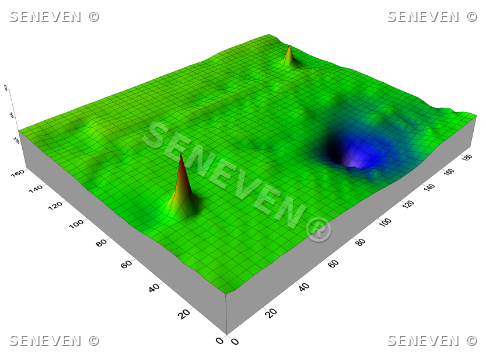
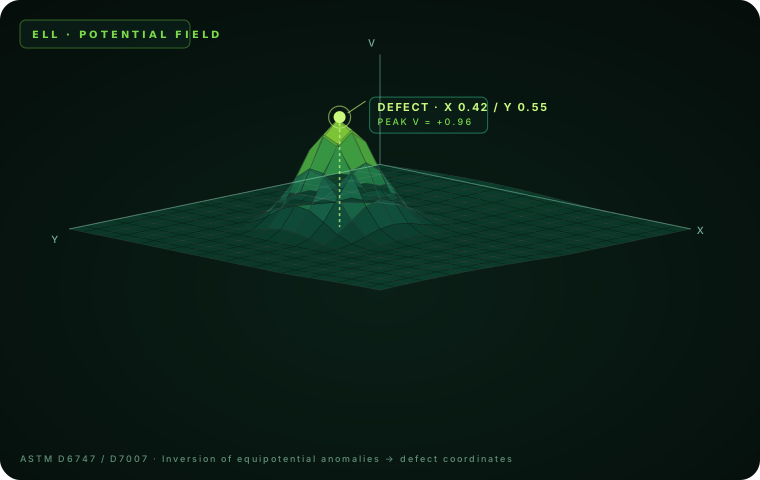
The system continuously samples potential at the sensor-electrode array and reconstructs the 3-D potential field on the cloud platform. An intact liner produces a smooth, near-uniform field; a defect creates a local low-resistance path, presenting itself as a sharp peak in the surface plot.
Inversion of the equipotential anomaly returns defect coordinates with sub-metre accuracy, visualised in 2-D / 3-D for the operations team. Combined with threshold-based alerts and full-lifecycle archival, every leak becomes a quantifiable, auditable engineering record.
Need technical support?
Contact the SENEVEN engineering team for a tailored detection or monitoring scope, scaled to your project type, footprint and field conditions.